
آخر الأخبار
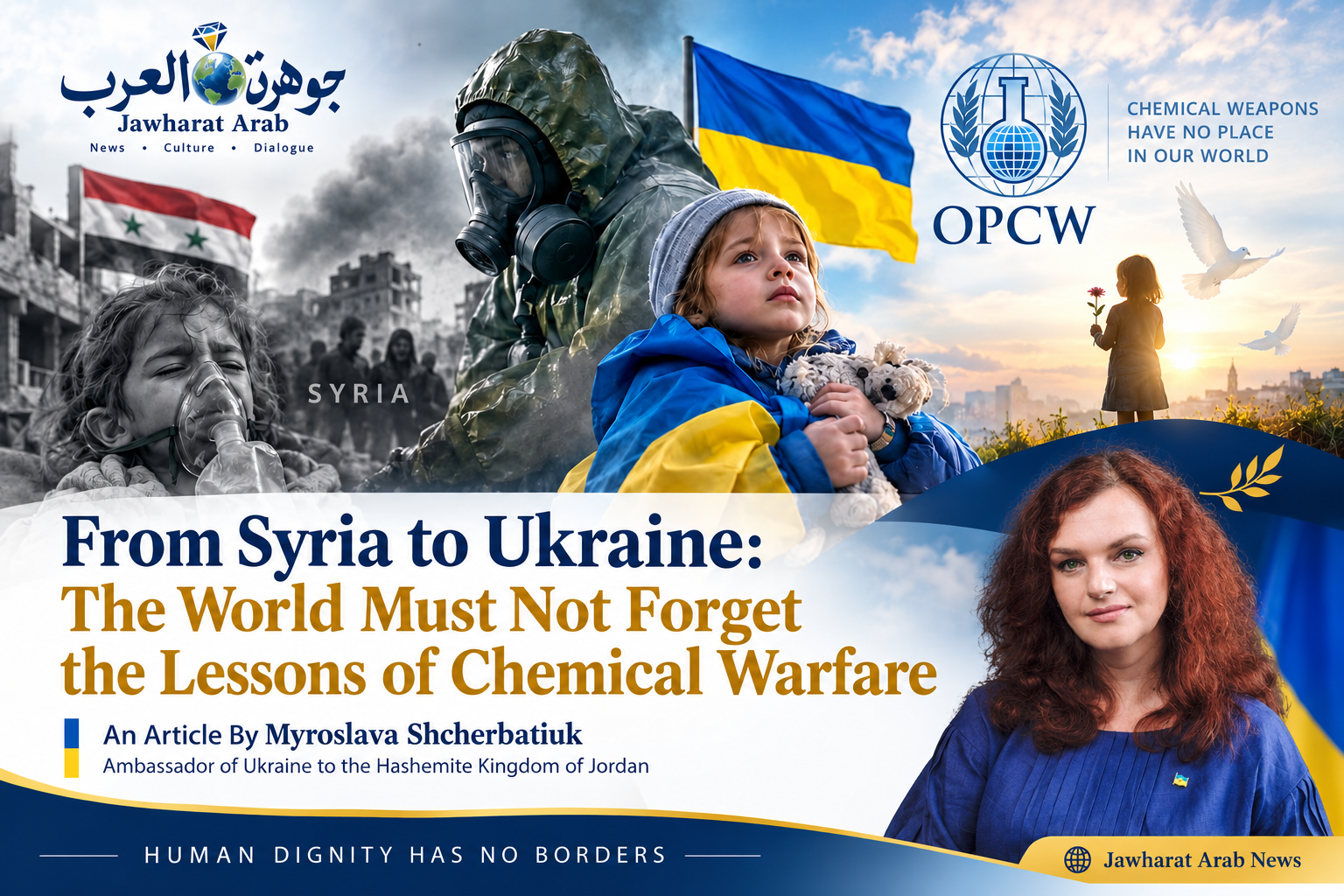
From Syria to Ukraine: The World Must Not Forget the Lessons of Chemical Warfare
Jawharat Arab New - An Article By Myroslava Shcherbatiuk, Ambassador of Ukraine to the Hashemite Kingdom of Jordan
There are weapons whose very existence challenges our understanding of humanity. Weapons that do not distinguish between a soldier and a civilian, that turn the air we breathe into an instrument of suffering, and whose victims may endure unimaginable pain.
Chemical weapons belong to this category. Their horrific legacy led the international community to make a solemn promise: never again. Yet today, that promise is being tested.
For Jordan, the horrors of chemical warfare are not distant memories from history books. The tragedy of neighbouring Syria brought these horrors painfully close to home. The images of children struggling to breathe, desperate parents searching for help, and entire communities devastated by chemical attacks shocked the conscience of the world. Jordan, which opened its doors to hundreds of thousands of Syrians fleeing war and persecution, understands better than many nations the human cost of conflict and the consequences of international inaction.
Today, as Russia continues its aggression against Ukraine, the world faces a deeply troubling reality: prohibited chemical agents are once again being used as instruments of warfare.
Have we truly learned the lessons of Syria?
When the Unthinkable Becomes Routine
Since the beginning of Russia’s full-scale invasion, Ukrainian authorities have documented a disturbing pattern of chemical agents being used against Ukrainian defenders. As of September 2026, Ukraine had recorded 14,009 incidents involving Russian munitions containing toxic chemicals. In 6,021 cases, Ukrainian servicemen sought medical assistance after experiencing symptoms consistent with chemical exposure.
Behind these numbers are human beings — soldiers struggling to breathe, suffering from severe irritation and other effects of exposure, while trying to defend their country. These are not merely statistics. They represent thousands of moments of suffering that should have no place in modern warfare. And the evidence goes beyond Ukraine’s own findings.
During 3 technical assistance visits conducted at Ukraine’s request, laboratories designated by the Organisation for the Prohibition of Chemical Weapons (OPCW) confirmed the presence of CS, a riot control agent, in samples collected in connection with reported incidents. No need to say that the Chemical Weapons Convention explicitly prohibits the use of riot control agents as a method of warfare. The OPCW’s findings provide independent scientific evidence supporting Ukraine’s concerns about the use of prohibited chemical agents on the battlefield.
What makes this particularly alarming is the risk that such practices gradually become normalized — that what once shocked the world begins to be treated as just another method of war. And history has already shown us where such normalization can lead.
The Lessons of Syria Must Not Be Forgotten
The people of the Middle East know the devastating consequences of chemical warfare.
Between 2014 and 2018, chemical attacks involving chlorine and sarin in Syria became symbols of the brutality of that conflict. International investigations documented the use of chemical weapons by the Assad regime, while Russia repeatedly used its position in the United Nations Security Council to obstruct international accountability efforts.
The failure to ensure effective accountability sent a dangerous message: even the gravest violations of international norms might carry insufficient consequences.
For Ukraine, Syria is not simply a historical parallel. It is an alarming history. When the international community fails to respond decisively to the use of chemical weapons, the prohibition itself becomes weaker. And when perpetrators believe they can escape responsibility, the risk of further violations grows.
The victims of chemical attacks may live in different countries, speak different languages, and belong to different cultures. But their suffering reminds us of a universal truth: human dignity has no borders, and neither should our commitment to protecting it. This is why the prohibition of chemical weapons must never become a matter of political convenience or selective enforcement. It is a responsibility shared by all nations.
International Rules Cannot Survive Without Accountability
The Chemical Weapons Convention, adopted in 1993 and entering into force in 1997, was one of the international community’s most significant achievements in the field of disarmament. Its purpose was clear: to exclude completely the possibility of chemical weapons being used against humanity. The Convention was built on the understanding that some methods of warfare are so cruel and indiscriminate that they must never be accepted, regardless of political circumstances.
Yet international agreements are only as strong as the willingness of states to defend them.
In this context, Russia’s record raises profound concerns.
Beyond its actions in Ukraine, Russia has faced international condemnation over the use of toxic chemical agents against individuals, including the poisoning of Sergei and Yulia Skripal in the United Kingdom and Russian opposition leader Alexei Navalny.
A series of international sanctions and restrictive measures adopted by the United States, the United Kingdom and the European Union reflects the seriousness of these concerns.
Nevertheless, Russia continues to deny responsibility and promote accusations against Ukraine. This makes independent international verification indispensable. The credibility of the OPCW depends on scientific evidence, impartial investigations and procedures that cannot be manipulated for political purposes. It must remain an institution that establishes facts — not one whose authority can be exploited to obscure them.
A Choice That Goes Beyond Diplomacy
At the end of November 2026, the international community will face an important decision.
States Parties to the Chemical Weapons Convention will elect members of the OPCW Executive Council for the 2027–2029 term. Russia, having failed to secure a seat in 3 consecutive elections, is once again seeking membership in this governing body.
This raises a fundamental question. Can a state whose conduct raises such serious concerns under the Chemical Weapons Convention be entrusted with helping govern the very organisation responsible for upholding it? This is not simply a matter of diplomatic representation or geopolitical competition. It is a question of credibility. Of responsibility. And of whether international institutions can preserve the moral authority necessary to fulfil their missions.
Allowing Russia to return to the OPCW Executive Council under these circumstances would send a deeply troubling message: that states accused of violating fundamental international rules may nevertheless be entrusted with shaping their implementation. The international community cannot afford such ambiguity.
Ukraine therefore calls upon States Parties to support the candidacies of Poland and Estonia — responsible and committed members of the OPCW that have consistently demonstrated their dedication to international law and the objectives of the Chemical Weapons Convention. This choice should not be understood merely as a political decision concerning one country. It is a decision about the standards we expect international institutions to uphold.
Remembrance Must Mean Responsibility
Every year, on 30 November, the world observes the Day of Remembrance for All Victims of Chemical Warfare. It is a day to honour those who suffered and died because humanity failed to prevent the use of some of its most horrific weapons. But remembrance alone is not enough.
We cannot honour the victims of yesterday while turning a blind eye to the suffering of today. We cannot condemn chemical attacks in one part of the world while treating similar violations elsewhere as an unfortunate but acceptable reality of war. And we cannot claim to defend the international rules-based order while allowing those rules to be weakened by impunity.
For the people of Syria, for the people of Ukraine, and for every community that has experienced the horrors of war, the promise of a world free from chemical weapons must remain more than words. Jordan and Ukraine may be separated by geography, but they share an understanding of the value of human life, the importance of international law, and the responsibility to protect future generations from the tragedies of the past.
The upcoming OPCW elections offer the international community an opportunity to demonstrate that these principles still matter. Ultimately, the choice is not simply about who occupies a seat at an international organisation. It is about whether the world is prepared to defend the promise it once made to humanity: never again.